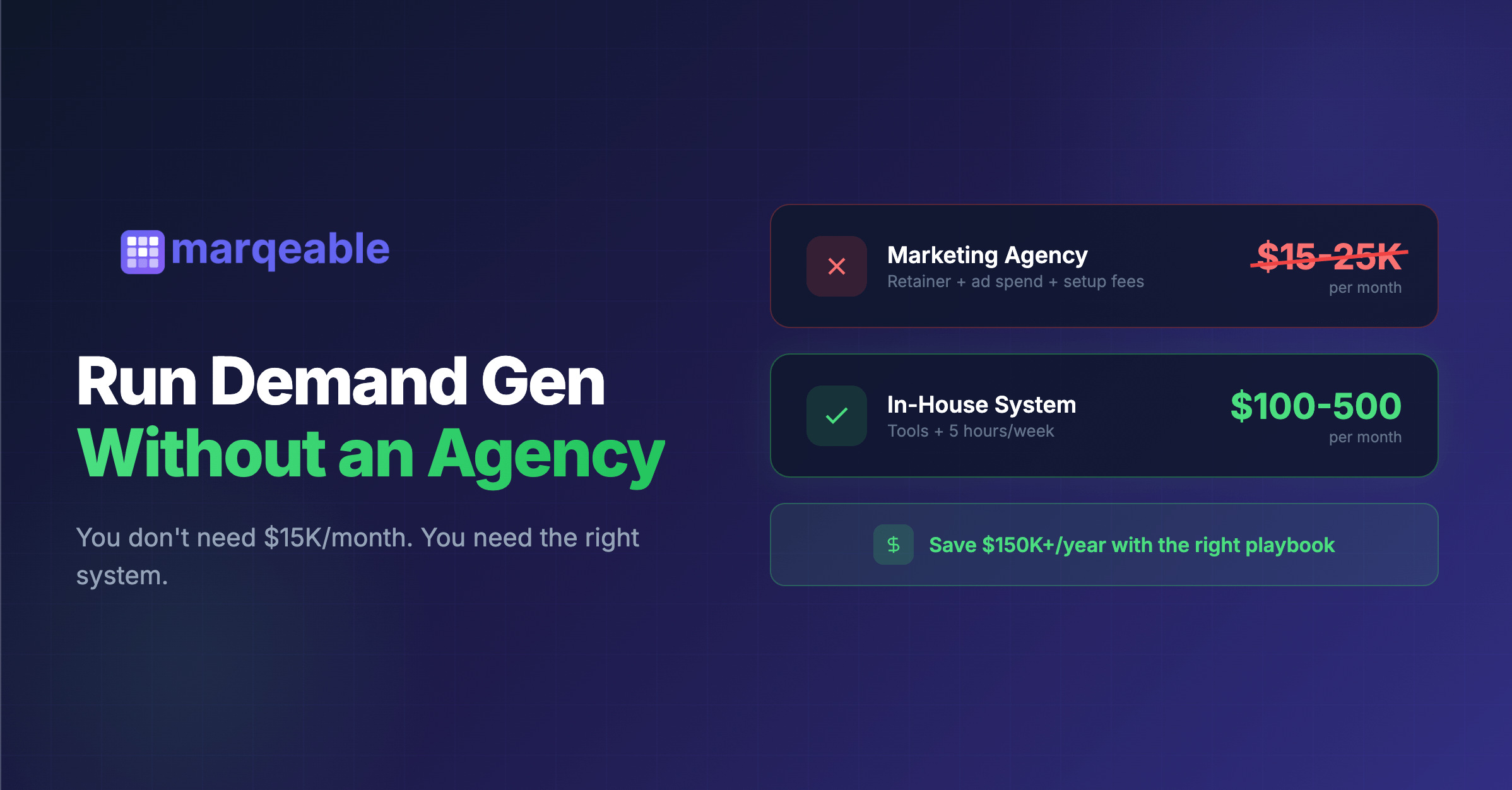
How to Run Demand Gen Without a Marketing Agency
“We need to hire an agency.”
It’s the default answer when a B2B startup realizes they need demand generation but don’t have a marketing team. Agencies have the expertise, the processes, the people. They’ll handle everything.
Then you see the proposals. $15,000/month. Six-month minimum. Plus ad spend.
For a startup watching runway, that’s a hard pill to swallow. Especially when you realize you’ll still need to provide briefs, review content, and answer questions constantly.
Here’s the truth: you can run effective demand gen without an agency. Many successful B2B startups do. It requires the right approach, but it’s more accessible than you think.
The Real Cost of Agency Demand Gen
Let’s be honest about what agencies charge:
| Service Level | Monthly Retainer | What You Get |
|---|---|---|
| Basic | $5,000-8,000 | Content + email, limited scope |
| Standard | $10,000-15,000 | Multi-channel, some paid media |
| Full-service | $15,000-25,000 | Comprehensive demand gen |
| Enterprise | $25,000+ | ABM, complex campaigns |
Plus:
- Ad spend (typically 2-5x the retainer)
- Setup fees ($2,000-10,000)
- Minimum commitments (3-6 months)
Annual cost for “standard” agency demand gen: $150,000-250,000
That’s a senior marketing hire. Or significant runway extension. Or product investment.
The Hidden Cost: Even with an agency, you’ll spend 10-15 hours per month on briefings, reviews, and feedback. They execute, but you still drive strategy and approvals.
Why Agencies Aren’t Always the Answer
Agencies have real value. But they also have structural limitations:
| Agency Reality | Impact |
|---|---|
| They don’t know your product | Ramp-up takes 2-3 months |
| You’re one of many clients | Not their top priority |
| Feedback loops are slow | Weekly calls, async reviews |
| They optimize for deliverables | Not necessarily outcomes |
| Knowledge doesn’t stay with you | When they leave, expertise leaves |
For early-stage startups, these limitations often outweigh the benefits:
- You’re still iterating on messaging
- You need fast feedback loops
- Budget is a real constraint
- Nobody knows your ICP like you do
The In-House Demand Gen Playbook
You don’t need a full marketing team. You need a system. Here’s what actually works:
Step 1: Define Your ICP (2-4 hours)
Before any campaign, get crystal clear on who you’re targeting:
| ICP Element | What to Define |
|---|---|
| Company | Size, industry, tech stack, growth stage |
| Buyer | Title, responsibilities, reporting structure |
| Pain | Specific problems they face daily |
| Trigger | What makes them look for solutions now |
| Objection | Why they might not buy |
Write it down. One page. This is your foundation for everything.
Step 2: Build Your Content Engine (Ongoing)
You don’t need a content team. You need a content system:
| Content Type | Effort | Purpose |
|---|---|---|
| Blog posts | 2-4 hours each | SEO, thought leadership |
| Email sequences | 4-6 hours per sequence | Nurture, conversion |
| LinkedIn posts | 30 min each | Awareness, engagement |
| Case studies | 4-6 hours each | Social proof |
| Landing pages | 2-4 hours each | Conversion |
The minimum viable content stack:
- 1 blog post per week
- 1 email sequence (5-7 emails) per quarter
- 3-5 LinkedIn posts per week
- 1 case study per quarter
That’s 8-10 hours per week. Doable for a founder or first marketer.
Step 3: Set Up Your Channels
Focus on channels where your ICP actually lives:
| Channel | Best For | Startup-Friendly? |
|---|---|---|
| Nurture, direct response | Yes - low cost, high control | |
| LinkedIn (organic) | B2B awareness, thought leadership | Yes - free, effective for B2B |
| LinkedIn (paid) | Targeted reach, ABM | Moderate - expensive but precise |
| Google Ads | Intent capture | Moderate - competitive keywords |
| Content/SEO | Long-term pipeline | Yes - compounds over time |
Start with email + LinkedIn organic. These cost nothing but time and reach B2B buyers effectively.
Step 4: Create Your Campaign Framework
Don’t reinvent each campaign. Build a repeatable framework:
| Campaign Element | Template It |
|---|---|
| Brief | Standard fields: goal, audience, offer, timeline |
| Email sequence | Structure: intro, value, social proof, CTA |
| Landing page | Layout: headline, pain, solution, proof, CTA |
| Follow-up | Timing and messaging for non-responders |
Once you have templates, campaigns go from weeks to days.
Step 5: Automate What You Can
You don’t need an agency to automate. Modern tools handle:
| Automation | Tools |
|---|---|
| Email sequences | HubSpot, Mailchimp, ConvertKit |
| Social scheduling | Buffer, Hootsuite, native tools |
| Lead scoring | HubSpot, Salesforce |
| Reporting | Built into most platforms |
The key: automate execution, not strategy. You decide what to send. Tools handle when and to whom.
The 5-Hour-Per-Week Demand Gen System
Here’s a realistic weekly schedule for a founder or solo marketer:
| Day | Activity | Time |
|---|---|---|
| Monday | Review metrics, plan week | 30 min |
| Tuesday | Write/edit content (blog or email) | 2 hours |
| Wednesday | LinkedIn posts, engagement | 30 min |
| Thursday | Campaign execution/optimization | 1 hour |
| Friday | Outreach, follow-ups | 1 hour |
| Total | 5 hours |
This isn’t full-scale demand gen. But it’s enough to:
- Build pipeline consistently
- Test messaging and channels
- Learn what works for your ICP
- Create foundation for scaling later
When In-House Works Best
| Situation | Why In-House Wins |
|---|---|
| Pre-PMF | You need fast iteration, not polish |
| Tight budget | $0-2K/month vs. $15K+ |
| Simple ICP | One persona, clear pain points |
| Founder-led sales | Marketing supports, doesn’t replace |
| Content-driven | Your expertise is the differentiator |
When You Might Actually Need an Agency
Be honest about when to bring in help:
| Situation | Why Agency Helps |
|---|---|
| Paid media at scale | Expertise matters, mistakes are expensive |
| ABM programs | Complex orchestration, specialized tools |
| No bandwidth | You have budget but zero time |
| Entering new market | Local expertise, established playbooks |
| Scaling fast | Need capacity now, not in 3 months |
The key question: Is this a capability gap or a capacity gap?
- Capability gap → Consider agency or specialized contractor
- Capacity gap → Consider automation, AI agents, or part-time hire
The Emerging Third Option: AI Marketing Agents
There’s a new category emerging between “do it yourself” and “hire an agency”: AI marketing agents.
Unlike traditional automation (which requires you to build every workflow), AI agents can:
| Traditional Automation | AI Marketing Agents |
|---|---|
| You build the workflow | Agent executes from a brief |
| Triggers and rules | Reasoning and adaptation |
| One task at a time | End-to-end campaign execution |
| Requires constant setup | Learns your brand and voice |
Think of it as having a junior marketer who never sleeps, never forgets your brand guidelines, and can execute campaigns while you focus on strategy. AI agent platforms like Marqeable are built specifically for this use case.
This doesn’t replace human judgment. You still define the strategy, approve the work, and make the calls. But the execution, the part that eats 80% of the time, gets handled autonomously.
The Capacity Multiplier: AI agents don’t solve capability gaps (you still need expertise for complex paid media or ABM). But they dramatically solve capacity gaps, letting small teams operate like much larger ones.
The Hybrid Approach
You don’t have to choose all-in-house or full-agency. Many startups use a hybrid:
| Function | Who Does It |
|---|---|
| Strategy | In-house (you know your market) |
| Content | Mix (in-house + freelancers) |
| Email/nurture | In-house (automation handles execution) |
| Paid media | Contractor or agency (specialized skill) |
| Design | Freelancer (as needed) |
This gives you control over strategy while accessing specialized skills for specific channels.
Tools That Replace Agency Functions
| Agency Function | DIY Alternative | AI-Augmented Alternative |
|---|---|---|
| Content strategy | ICP research + competitor analysis | AI analyzes competitors and suggests angles |
| Copywriting | AI writing tools + your expertise | AI drafts in your brand voice, you refine |
| Design | Canva, Figma templates | AI-powered design tools |
| Email marketing | HubSpot, Mailchimp | AI agents build and optimize sequences |
| Social management | Buffer, native scheduling | AI generates and schedules content |
| Analytics | Built-in platform analytics | AI surfaces insights and recommendations |
| Campaign orchestration | Manual coordination | AI agents execute end-to-end |
The tooling gap between agencies and in-house has nearly closed. And with AI agents handling execution, the capacity gap is closing too. What remains is strategic judgment, and that’s exactly what founders and early marketers should focus on.
Key Takeaways
| Myth | Reality |
|---|---|
| ”You need an agency for demand gen” | You need a system, not an agency |
| ”In-house requires a marketing team” | 5-10 hours/week can build real pipeline |
| ”Agencies handle everything” | You still drive strategy and approvals |
| ”DIY means lower quality” | Your product knowledge is an advantage |
| ”It’s agency or nothing” | Hybrid approaches often work best |
The Bottom Line
You don’t need $15,000/month to run demand gen. You need:
- Clear ICP definition
- A repeatable content system
- Smart automation (or AI agents) to handle execution
- Strategic time focused on what matters
Agencies have their place. But for most early-stage B2B startups, in-house demand gen isn’t just possible. It’s often better. Faster iteration, tighter feedback loops, and knowledge that stays with your company.
The real unlock? Stop thinking about it as “agency vs. DIY.” Think about it as “what should humans do vs. what should be automated?” Strategy, creativity, and judgment stay with you. Execution, coordination, and repetitive tasks get automated or handled by AI.
Start small. Build the system. Let AI handle the grunt work. Scale when you’re ready.
Frequently Asked Questions
Can I run demand gen without a marketing agency?
Yes. Many B2B startups successfully run demand gen in-house. The key is having clear ICP definition, a repeatable content system, and the right automation tools. Agencies add value for scale and specialized expertise, but are not required to get started.
How much do B2B marketing agencies cost?
B2B demand gen agencies typically charge $10,000-25,000 per month for retainer engagements. Project-based work ranges from $5,000-50,000 depending on scope. Most agencies require 3-6 month minimum commitments.
What do I need to run demand gen in-house?
Four essentials: (1) Clear ICP and messaging, (2) Content creation capability (even basic), (3) Email and marketing automation platform, (4) 5-10 hours per week dedicated to execution. You do not need a full-time marketer to start.
When should I hire an agency vs. do demand gen in-house?
Consider an agency when: you need specialized expertise (paid media, ABM), you have budget but no time, or you need to scale quickly. Stay in-house when: budget is tight, you are still finding product-market fit, or you need fast iteration cycles.
Related Resources
B2B Demand Gen on a Startup Budget: No Agency, No New Hires
The complete playbook for resource-constrained startups.
Why Your 3-Person Marketing Team Feels Like 0.5
The coordination tax that kills small team productivity.
Stop Building Campaigns in 5 Different Tools
How tool sprawl slows down your marketing.
About Marqeable
Marqeable builds AI marketing agents that help startups run demand gen campaigns without agencies or large teams.